.
16 July 2012 - Updated November 2012
United Nations Arts
Initiative
Arts Integration Into
Education
Url: www.unarts.org
Twitter: unarts
Facebook: unarts
Joint
Health - The Evolution of Classical Ballet Based Biomechanics
Classical ballet training
represents the most advanced technical movement mechanics training in
the world. The mechanical alignment ideal in classical
ballet training represents the most stable, functionally integrate
relationship of the spine and extremities.
An understanding of mechanical
ideal is crucial for optimum control of the human frame in space,
strength, leverage mechanics and economical movement. This foundation
established in conjunction with sports specific movement mechanics is
the key to successful Olympic development programs.
A correct understanding of the
classical ballet mechanical ideal provides the
physician, therapist, coach or student a reference point for alignment
deviation as it corresponds to the mechanism of joint stress and injury
of the spine and extremities.
According to the Merck
Manual of Medical Information for Sports Injuries: "More than 10
million sports injuries are treated each year in the United
States." The seriousness of this problem points to the need for
education initiatives which target injury prevention.
-- Classical
Ballet Based
Biomechanics
and Orthopedic Analysis Level 1: Sports Medicine
& Science Institute.
Stephen M. Apatow, founder of the Sports
Medicine & Science Institute
International Dancescience Development Program is known as the
pioneer of classical ballet-based biomechanics and orthopedic
analysis.
Sports
Science: Professional and
Academic Experience includes:
- Academic: Exercise Physiology,
Sports Medicine, Sabbatical 1984.
- 1984-90: Full time training for
ultra distance running, ultra-distance cycling, national &
international level competition in cross country skiing and
rowing.
- 1985:
Accepted to the national development camp
for cycling, Olympic Training Center, Colorado Springs,
Colorado.
- 1986-89: Through the help of Tony Johnson, heavyweight
rowing coach at Yale, began cross training sweep rowing and sculling
with the New Haven Rowing Club.
- Studied modern, jazz and ballet
training at the Lee Lund Academy from 1985-88 and the Soviet System of
Ballet Training at the Nutmeg
Conservatory for the Arts from 1986-89. Honorary Graduate of the
Nutmeg Conservatory for the Arts Professional Program in 1989.
- 1987: Presentation at
Rossignol Cross Country Ski Clinic, speakers included Bill Koch and
Lyle Nelson coordinated by Mike Gallagher, (former Olympian and Olympic
Cross-Country Ski Coach), Mountain
Top Inn, Chittenden,
Vermont.
- Martial Arts: As a participant
in the study
of martial arts for over 20 years, classical ballet training provided a
scientific method (utilizing a similar approach used in eastern bloc
development programs) to optimize speed, strength, leverage mechanics,
force generation and technique. Current training emphasis is
Judo/Jujitsu. Founder: JudoSport
International.
- Technical consultant for Cheryl
Madeux, Finalist, Lausanne International Ballet Competition
in 1990.
- Technical consultant for U.S.
National Team athletes from Harvard University, members of World and
Olympic Festival Teams. Sports applications include professional
football, national level wrestling, hockey cross-country and downhill
skiing, skating and martial arts.
- Speaker at 1990 Coaches
Association Meeting for Sport Canada at the Olympic Complex in Ottawa,
Canada.
- Upon request, applications of
the analysis correction and retraining procedures to enhance the joint
flexibility and technical performance for classical ballet training
have been applied to musculo-skeletal disorders that include entrapment
neuropathies, Scoliosis, Rheumatoid Arthritis, Asthma, Fibromyalgia, Frederick's Ataxia and Multiple Sclerosis.
One of our cases with Rheumatoid Arthritis was submitted to the
National Arthritis Foundation Peer Review Board in 1990. Analysis and
corrective procedures have been adapted to help spinal herniations for
physicians at Yale Medical School.
- Small animal veterinary
application of human
biomechanics procedures leads to work with hundreds of horses in
dressage, hunter-jumper and western training programs. (See: Expanding
Human to Veterinary Biomechanics Applications)
- 1994-98: Corrective procedures
developed to enhance the technical ability of the international level
dancer in ballet were adapted into dressage and hunter-jumper specific
training programs for both horse and rider. This work was formally
introduced as an equestrian
development program at the USDF Adult Camp in Boise, ID in
1997. In 1998, the USDF Region V Adult Camp in Jackson
Wyoming provided USDF University Credit for the lecture presentation on
"Biomechanics and Structural Analysis of Both Horse and Rider."
- 1999: Presenter at Society of
State Directors of Health, Physical Education, and Recreation Annual
Meeting, Boston, Massachusetts.
- 1999 - Present: Research and
development of programs associated with the optimization of classical
ballet training, Olympic development programs and specialized
orthopedic applications.
- 2002 International Sports
Science Association Fitness Therapist Review: The Science and Practice
of Rehabilitative Exercise integrate theory
and practice in the health care arena. This specialized field utilizes
information from the world of rehabilitation, pathology, functional
anatomy and physiology and blends it with the world of fitness training
dealing with aerobic conditioning strength training, skill development,
exercise progression and prescription for special population
groups.
- 2003: "Optimization of
Classical Ballet and Sports Development Programs" workshop was
introduced at the 11 state American Alliance for Health, Physical
Education, Recreation and Dance (AAHPERD) Combined Convention on
February 12, 2003 in Reno-Sparks, Nevada.
- Currently on faculty at the
Nutmeg Conservatory for the Arts, director of the International
Dancescience Development Program. Consultancy work with all sports
and Olympic development programs continues through JudoSport
International, encompasses classical ballet based
biomechanics training
through martial arts based technical skill development.
Testimonials
- "I can only say that Mr. Apatow's
technique seemed to work in this case (C5,6 entrapment
neuropathy) more efficiently than any other method tried,
including both medicinal and physical therapy." Richard E. Kaufman,
M.D., P.C., Yale Medical School.
- "As a 52 year old sufferer of various
severe sports related injuries for most of my adult life. i.e. back,
neck, shoulder, etc. I have been treated by neurologists,
orthopedics, psychotherapists, and chiropractors using most forms
of conventional therapy and medicinal procedures. From this
experience, I can state that Steve Apatow's special treatment of
joint injuries has proven the most effective procedure, from both
a short-term and long-term standpoint." Richard Norris,
Research and Development Engineer - opened discussion at MIT for the
development of a CAD analysis system that could be used with Cat Scan
or MRI.
- "This type
of training will be a major thing of the future." Sharon
Dante, Nutmeg Ballet Company (Gold medalist coach, 1984 International
Ballet Competition, New York City).
Professional
Memberships (Former/Current)
- American College of Sports
Medicine (ACSM)
- International Sport Science
Association (ISSA)
- American Alliance for Health,
Physical Education, Recreation and Dance (AAHPERD)
- International Society of
Biomechanics in Sports (ISBS)
- National Dance Association (NDA)
- American Association for Health
Education (AAHE)
- National Association for Sport
& Physical Education (NASPE)
Learn more, on the
web at:
Sports Medicine & Science Institute
Url: www.esportsmedicine.org
International
Dancescience Development Program
Url: www.edancescience.org
Ballet Equestria
International Equestrian Development Program
Url: www.balletequestria.org
-----------------------------------------------------------
Nutmeg
Nuggets: Staying in peak condition: Register Citizen,
Torrington,
Connecticut, 13 June 2012.
The Register Citizen
(registercitizen.com), Serving Torrington, CT
The posture of a dancer is visibly
evident. Just watch a Nutmeg Conservatory for the Arts dancer walk down
Main Street in Torrington with her back held straight, her shoulders
pulled back and an air of confidence. That posture is what makes those
beautiful body lines you will see on the stage at Warner Theatre when
the Nutmeg Summer Dance Festival opens in July.
Ballet is such a graceful art that sitting in a theater watching a
performance one could be fooled into thinking that the dancers are
floating across the stage. But that’s an illusion. Ballet dancers, like
ball players, skaters, gymnasts, etc., are athletes who must keep their
bodies in peak condition in order to perform to the best of their
ability. A good diet, vitamin supplements and stretching at the ballet
barre help keep a dancer fit. But being supple and fit and maximizing a
body’s potential takes more and that’s where Stephen M. Apatow comes in.
Apatow is the founder and director of the Sports Medicine and Science
Institute, which has a base at the Conservatory. As a former dancer and
a 1989 Nutmeg graduate, he understands the importance of the body’s
need to be in balance, or in other words, perfectly aligned. He works
with students, teachers and guest artists at Nutmeg to help them
achieve that body balance.
“I assess the dancers to see if they have posture challenges that can
be corrected. When movement of a joint is restricted, specific
stretches are utilized to give it new range of motion. When a dancer
has been training one way for a long time, a joint may need to be
retrained to give it better range of motion,” Apatow said.
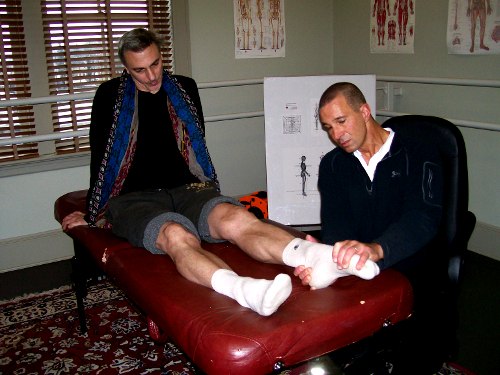
He teaches the dancers and his other clients the specific exercises to
increase flexibly and motion of the joint. “Then I take them to the
barre and do technical classical ballet corrections and retrain them in
the classical ballet specifics. Sharon and I have worked together on
these exercises and positions for over 20 years.”
Apatow first brought his program to Nutmeg when executive director
Sharon Dante asked him to work with Cheryl Madeux as she prepared for
the 1990 Lausanne international ballet competition. His work resulted
in an increased range of motion in her hips, and her spinal and
shoulder alignment and cervical spine alignment was corrected. And she
could do an amazing split!
“After working with Cheryl she went from opening a 160 degree split to
a 180 degree split,” he said.
The one-month intensive program Apatow designed for Madeux resulted in
her moving to the next technical level of performance, an
accomplishment it was believed she could not have done through the
classical ballet program alone. It also paid off when she became the
only American finalist at the Prix de Lausanne.
The Sports Medicine and Science Institute and International
Dancescience Development Program emphasizes the importance of postural
analysis, based on the classical ballet mechanical ideal, according to
the website. However, there’s more to it than that.
“Stephen is our biomechanics expert and he works with the students and
the staff. He is also available to people in the community,” Dante said.
Apatow works with people who have musculoskeletal issues or ailments,
including entrapment neuropathies, scoliosis, rheumatoid arthritis,
asthma, fibromyalgia, friedreich ataxia, multiple sclerosis and more.
He is available by calling Nutmeg and making an appointment. Apatow has
used his biomechanics expertise with Olympic athletes and has even
helped veterinarians with canine and equine cases.
To schedule an appointment with Stephen Apatow, call The Nutmeg
Conservatory for the Arts at 860-482-4413 ext 308. To purchase tickets
for the Nutmeg Summer Dance Festival on Friday July 27 at 8 p.m. or
Saturday July 28 at noon, call the Warner Theatre box office at (860)
489-7180 or online at www.warnertheatre.org.
###
|